
A trip through a 1970s grocery store could turn up prices that seem almost impossible today, from eggs costing less than a dollar a dozen to household staples selling for just a few cents. But the decade had its own inflation problems, and those old price tags tell a more complicated story than nostalgia alone suggests. These grocery prices offer a fascinating look at what Americans put in their shopping carts and how the cost of everyday life has changed.
A dozen eggs for 61 cents

A dozen eggs averaged around 61 cents in 1970, but the price in any particular store could be different. A California supermarket advertisement from that February shows why sale prices should not be mistaken for national averages. Those tiny numbers are irresistible to look at, though they do not tell the whole story about household buying power.
White bread at 36 cents a pound

In 1975, white bread averaged 36 cents per pound, according to the Bureau of Labor Statistics. The unit matters: a loaf and a pound are not always identical, so comparing package prices can distort the picture. Even such an ordinary sandwich staple makes an excellent time capsule.
Milk at 78.5 cents a half gallon

The BLS recorded a 1975 average of 78.5 cents for a half gallon of milk. Double that quantity and the equivalent gallon would cost $1.57 at the same per-unit rate, before accounting for differences in package pricing. For families buying several cartons a week, small changes mattered.
Butter for $1.03 a pound

A pound of butter averaged $1.03 in 1975. Butter was already a substantial grocery expense compared with many produce staples, which helps explain the appeal of lower-priced substitutes. A period package or store circular makes that difference tangible.
Round steak for $1.89 a pound

Round steak averaged $1.89 per pound in 1975, one of the bigger numbers on a mid-decade shopping list. Meat prices were a major concern as food inflation disrupted family budgets. The familiar steak counter offers a useful reminder that the seventies were not uniformly cheap.
Apples at 34 cents a pound

A pound of apples averaged 34 cents in 1975, according to federal retail-price figures. That is a useful national benchmark, unlike a single store promotion. The fruit aisle puts the apparent simplicity of old price tags into perspective.
Potatoes at 13.4 cents a pound

Potatoes averaged 13.4 cents per pound in 1975. Few items show the visual shock of old grocery prices as clearly as a produce sign marked in pennies. The figure also shows why grocery comparisons need consistent quantities.
Bananas at 23.2 cents a pound

The BLS put bananas at an average of 23.2 cents per pound in 1975. Those familiar yellow bunches were already a supermarket staple, making the number instantly recognizable to readers. Their price history also resists easy claims that every grocery item rose equally.
Rice at 47 cents a pound

Rice averaged 47 cents per pound in the United States in 1975. Looking at the per-pound measure avoids confusing a small bag with a much larger one. It is a straightforward example of how economists compare common groceries across time.
Pork chops at $1.16 a pound

Pork chops cost about $1.16 per pound in 1970, as reported in retrospective grocery-price research. Their inflation-adjusted price tells a different story from the eye-catching original tag. A butcher-counter photograph can show why meat became such a prominent symbol of seventies food bills.
A quart of Joy for 75 cents

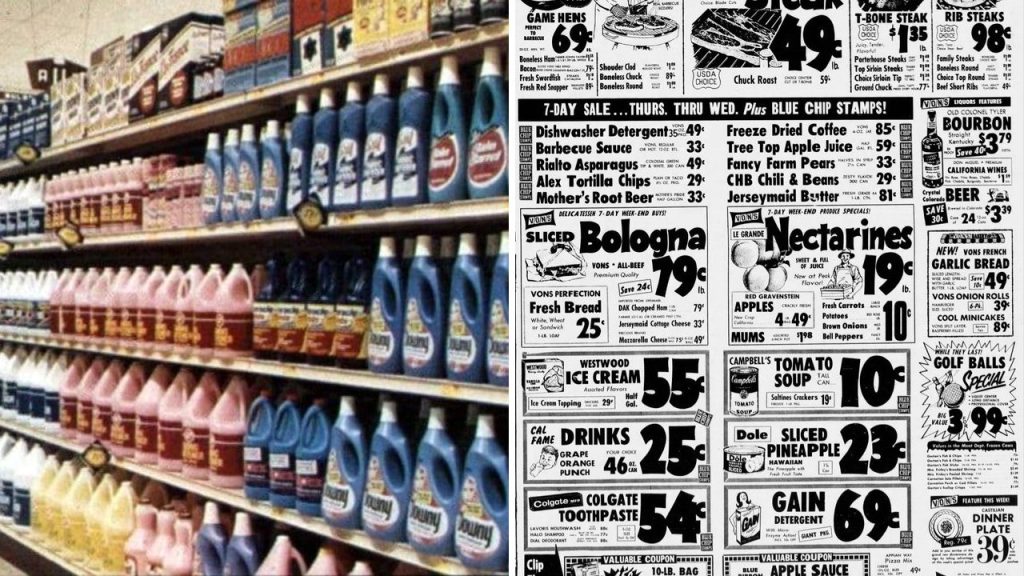
A one-quart bottle of Joy dishwashing liquid was reported at 75 cents in 1972. The bottle size is essential to the comparison, especially since modern detergents can differ in concentration. Kitchen cleanup was another routine cost families saw on weekly store runs.
Cheerios around 59 cents a box

Cheerios were reported at about 59 cents a box in 1977. Box sizes and formulations change, so an old carton price cannot be compared blindly with a modern one. But the packaging alone is likely to bring back memories of the breakfast table.
Corn Flakes for 50 cents

A box of Kellogg's Corn Flakes was reportedly 50 cents in 1977. The iconic name makes this a strong nostalgia entry, particularly if paired with the package from that year. We would need the precise box weight before claiming an apples-to-apples modern price comparison.
Two Bounty rolls for 39 cents

Two rolls of Bounty paper towels were reportedly priced at 39 cents in 1973. Modern roll-size labels complicate comparisons because a double roll does not match every historic package. It is the kind of detail a grocery receipt alone might conceal.
A Coke bottle for 15 cents

A bottle of Coca-Cola reportedly sold for around 15 cents in 1970. At the time, that was already more than the ten-cent price remembered from the previous decade. Familiar brands reveal how people noticed rising prices long before our own era.
Six Pepsi cans for 69 cents

A six-pack of 12-ounce Pepsi cans was reportedly available for 69 cents in 1972. By 1974, the same source describes a price closer to 88 cents. That two-year change helps show how inflation was felt within the decade itself.
A gallon of ice cream around $1.29

A gallon of vanilla ice cream reportedly sold for about $1.29 during the 1970s. This is an approximate decade-level figure, not a national average for a specified year. The size also matters, since many modern ice cream containers are smaller than they once were.
Two pounds of margarine for 89 cents

A two-pound package of Fleischmann's margarine was reportedly 89 cents in 1973. Shoppers comparing it with butter were making a practical decision, not just a taste preference. The side-by-side dairy case is a revealing little portrait of household budgeting.
Orange juice advertised for 18 cents

An advertisement described by Money Digest reportedly offered canned orange juice for 18 cents in a 1974 newspaper. That is a local promotional price, not a national average, and the can size still needs to be checked against the original print ad. It nevertheless captures the appeal of bargain-driven grocery marketing.
Coffee for 79 cents a pound

A February 18, 1970, Fair-Med grocery advertisement in The Sacramento Bee offered a one-pound can of Folgers coffee for 79 cents. This was one retailer's printed promotion, not the nationwide average. The large price type in the original ad practically tells the story by itself.
Steak advertised for 99 cents a pound

The same 1970 Fair-Med advertisement promoted select Idaho steer beef steaks at 99 cents per pound. The sign lists several cuts, so it should not be presented as the regular price of every steak in America. It shows how aggressively supermarkets used meat specials to bring in shoppers.
A beef roast for 79 cents a pound

A standing-rib or rump roast appears at 79 cents a pound in the February 1970 Fair-Med newspaper ad. Comparing that number with today requires care about cut and quality. As an archival visual, however, the oversized 79-cent price is hard to beat.
Swiss steak advertised at 89 cents

A February 1970 California newspaper ad advertised certain steak cuts, including Swiss steak, at 89 cents a pound. The specific offer is evidence of an actual posted price in one market. It also reminds us how much variety a single meat-counter advertisement could contain.
A package of franks for 49 cents

The Fair-Med ad labels its all-meat franks as a 12-ounce package priced at 49 cents. Hot dogs were a lunchbox and cookout staple, and the package quantity is part of the story. A modern comparison must use the same weight.
Breakfast links for 27 cents

The 1970 Fair-Med ad offered an eight-ounce package of breakfast links for 27 cents. This is a promotional price tied to a specific newspaper date. The breakfast sausage label gives us a vivid archival detail without relying on a generalized memory of cheap groceries.
Hamburger or hot dog buns for 29 cents

A February 1970 supermarket ad priced an eight-count package of hamburger or hot dog buns at 29 cents. The quantity makes it possible to interpret the deal correctly. Just as today, stores used small everyday essentials to make a weekly circular appealing.
Frozen TV dinners for 49 cents

Swanson TV dinners appear in the Fair-Med ad for 49 cents each, with several varieties listed. It is an unmistakably seventies supermarket image: a complete meal sold for convenience. The printed price also connects changing eating habits with grocery-store competition.
Sugar in a two-for-29-cent offer

The Fair-Med circular advertised one-pound boxes of brown or powdered sugar at two for 29 cents. This was a multiple-item special rather than the standard price for one box. That distinction is precisely why reading the original advertisement matters.
Giant-size Gain for 69 cents

A giant-size package of Gain laundry detergent was advertised at 69 cents in the February 1970 Fair-Med circular. Giant size was marketing language, not a standardized weight, so we should not turn it into a direct per-ounce comparison without the package details. The brand-new-looking packaging and enormous price typography are a visual hook.
A full-page grocery ad from 1970

An August 1970 grocery advertisement from the Daily News Post gives us a vivid snapshot of how supermarkets competed for shoppers. Rows of specials and oversized price figures turned the weekly circular into a shopping guide. The prices may look astonishing now, but the ads also capture how carefully families watched their grocery budgets.