
A hat once did more than finish an outfit. It could identify a soldier, protect a farmworker, advertise a business, or make an entertainer impossible to miss. These surviving photographs and period illustrations reveal the surprisingly varied headwear of nineteenth- and early-twentieth-century America.
Lincoln and the battlefield top hat

Abraham Lincoln wore his towering top hat while visiting the Union encampment near Antietam in 1862. In Alexander Gardner's photograph, he stands between Allan Pinkerton and Gen. John A. McClernand, each dressed very differently for the occasion. A hat associated with formal civilian life had followed the president into a military camp.
The Union soldier’s uniform cap

An unidentified Black Union soldier posed with his wife and two daughters during the Civil War, between 1863 and 1865. His military uniform and headwear make the family's ambrotype more than a conventional portrait. The photograph preserves both a soldier's service and the people waiting beyond the battlefield.
The milliner’s own family portrait

An ambrotype dating to about 1854 identifies its subjects simply as a milliner and her daughter. The occupation matters: a milliner made or sold the elaborate women's hats that were part of mid-nineteenth-century dress. The image gives a rare personal face to a trade usually represented by finished accessories.
The hat that inspired an 1875 print

Currier & Ives published a lithograph called The New Hat Man in 1875. Its title makes headwear the selling point, at a time when hats could be recognizable elements of a person's public appearance. This is a period illustration rather than a candid photograph, an important distinction for the gallery.
Mary Ann Donaldson’s 1875 headwear

Photographer Julius Ulke made a portrait of Mary Ann Donaldson in Washington, D.C., in 1875. Her hat is part of a carefully presented nineteenth-century likeness, when studio portraits recorded clothing as well as faces. What survives is one individual's choice of dress, not just an anonymous fashion plate.
Zora Neale Hurston’s tilted hat

Carl Van Vechten photographed writer and anthropologist Zora Neale Hurston in 1938 wearing a dark hat angled across her forehead. Its sharply tilted brim gives the portrait an unmistakable personality. Unlike an anonymous millinery advertisement, this image connects a specific style to one of America's major literary voices.
One couple, two dress codes

The C.M. Bell studio photographed the Weir portrait in Washington between 1901 and 1903. The Library of Congress classifies the image under hats and women's dress, making the accessories part of its historical interest. Even an ordinary studio sitting could preserve fashion details that written records leave out.
Jackie Robinson’s Dodgers baseball cap

A 1951 comic-book cover showed Jackie Robinson in a Brooklyn Dodgers baseball cap. The image was an illustration, not a photograph of Robinson in the field, but the cap identifies him instantly as a ballplayer. In a gallery full of elaborate feathers and formal brims, this familiar piece of sportswear tells a very different kind of hat story.
The portrait labeled M. Stellwagen

A Washington studio photograph cataloged as M. Stellwagen dates to roughly 1903 to 1905. The Library of Congress includes it among its historical hat images, a reminder that headwear appeared in ordinary portraits as well as fashion advertising. The catalog's limited identifying information is part of the story: not every carefully dressed sitter can be fully reconstructed today.
Hats on San Francisco’s Chinatown streets

Arnold Genthe photographed Chinese American men and children in San Francisco's Chinatown sometime between 1896 and 1911. Their clothing and headwear belong to an actual neighborhood scene, not a costume illustration. The photograph also reminds us that historic American dress never followed just one cultural tradition.
The students learning to make hats

A Bain News Service photograph shows a millinery class in the 1910s or 1920s. Instead of concentrating on the person who bought a finished hat, the camera turns toward the people learning how to make them. Elaborate fashionable headwear depended on skilled work that was often invisible in the final portrait.
Chicago’s spring hats of 1900

A lithographed advertisement for Chicago's D.B. Fisk & Co. announced its spring 1900 offerings. At the turn of the century, hat fashions were circulated through commercial pictures as well as shop windows. This particular image documents what a millinery business chose to promote, rather than proving that every pictured style was widely worn.
The hatband that advertised personality

A 1910 poster for Wick fancy hatbands told customers to show their colors. It suggests how even a familiar hat could be personalized with a more eye-catching band. The advertising copy is an unusually direct glimpse of how makers sold individuality more than a century ago.
A messenger boy’s working hat

Twelve-year-old Leo Day was photographed in Tampa, Florida, in March 1911 by Lewis Hine. The Library of Congress identifies him as a postal telegraph messenger, one of the working children Hine documented. His headwear is part of a real street-trade uniform, but the larger story is the child's workday.
Clara Blackburne’s polished portrait

A Bain News Service photograph from about 1905 shows Miss Clara Blackburne with a Maltese terrier named Sonnette II. The Library of Congress placed the portrait in its hats selection, putting her headwear alongside the carefully arranged studio scene. It is a small example of how fashion, photography, and personal display met before social media existed.
The hats hanging in a Texas home

Russell Lee photographed a hat rack inside a Mexican farm home in Hidalgo County, Texas, in 1939. There is no glamorous model here, only everyday headwear where its owners kept it. That detail tells us something a posed portrait cannot: a hat was part of daily household life.
Workday hats in New Mexico

Russell Lee photographed women plastering an adobe house in Chamisal, New Mexico, in July 1940. Their hats appear in the context of outdoor labor, where practical clothing mattered more than fashionable display. The photograph records the people doing the work as clearly as the building they were repairing.
An 86-year-old farmer’s hat

Jack Delano photographed H.R. Wilson, an 86-year-old farmer near Cedar Grove, North Carolina, in 1940. Here, a man's hat belongs to his working identity rather than a formal occasion. The detail is meaningful precisely because the archive preserves his name, age, and place.
A cowboy hat marked with cattle brands

In San Angelo, Texas, Russell Lee photographed a hat with cattle brands burned into its surface in March 1940. This is an unusually literal meeting of ranching imagery and personal headwear. Instead of adding a ribbon or feather, the owner had a design language associated with livestock right on the hat.
Sombreros on sale in Puerto Rico

A 1900 stereograph shows sombreros for sale in the market at Yauco, Puerto Rico. The hats appear as merchandise, evidence that island shoppers had their own local choices of everyday headwear. It also broadens the gallery beyond mainland American streets.
Palm-leaf hats made in the Virgin Islands

Jack Delano photographed palm-leaf hatmaking in a small settlement on St. Thomas in 1941. The hats were being made for sale through a handicrafts cooperative, connecting a practical local material to paid craft work. A finished hat can hide the hands and knowledge needed to produce it.
The railroad engineer’s cap

Robert Perry worked as a railroad engineer on the Central Railroad of New Jersey and lived in Upper Mauch Chunk, Pennsylvania. Jack Delano photographed him in 1940, preserving a worker whose clothing reflected his occupation. Railroad headwear was not red-carpet fashion, but it belonged to the machinery of everyday America.
What women wore at the roundhouse

Women working as locomotive wipers took a lunch break at a Chicago & North Western Railway roundhouse in Clinton, Iowa, in April 1943. Jack Delano photographed them in color, capturing the clothing worn by women doing maintenance work during World War II. Their workday scene makes a useful contrast with the staged millinery portraits earlier in the gallery.
The caps of Black Army nurses

A 1944 photograph shows African American nurses getting off an Army truck and boarding a train on their way to overseas duty. Their military clothing, including headwear, belongs to a moment of professional service rather than a fashion shoot. The scene makes the purpose of the uniform impossible to ignore.
Knitted hats for children

A photograph in the American National Red Cross records shows children's knitted hats and dates from between 1919 and 1929. The image treats warm headwear as something to be made and supplied, not simply displayed. It is a quieter piece of clothing history, tied to care and practicality.
The sailor cap on a cross-country bicycle

Tony Pizzo posed with a sailor's cap and a bicycle bearing the words 'New York to Los Angeles and Return.' The original photo caption adds a remarkable detail: on his coast-to-coast ride, Pizzo was handcuffed to his machine. The cap is memorable, but the strange cycling stunt gives the picture its story.
Matthew Henson’s fur hat

Arctic explorer Matthew Alexander Henson was photographed in a fur hat and coat around the era of his polar expeditions. The clothing is a stark departure from the city hats seen elsewhere in this gallery: here, insulation mattered more than elegance. His portrait also places a Black explorer into a visual history too often told through a much narrower cast.
A jazz-era hat on Dizzy Gillespie

William P. Gottlieb photographed trumpeter Dizzy Gillespie in New York in about May 1947. The Library of Congress includes a portrait of Gillespie in its hats selection, placing modern musical style alongside work caps and Victorian millinery. By then, headwear could signal a different cultural world without needing an elaborate feather or towering brim.
Lillian Russell’s towering feathers

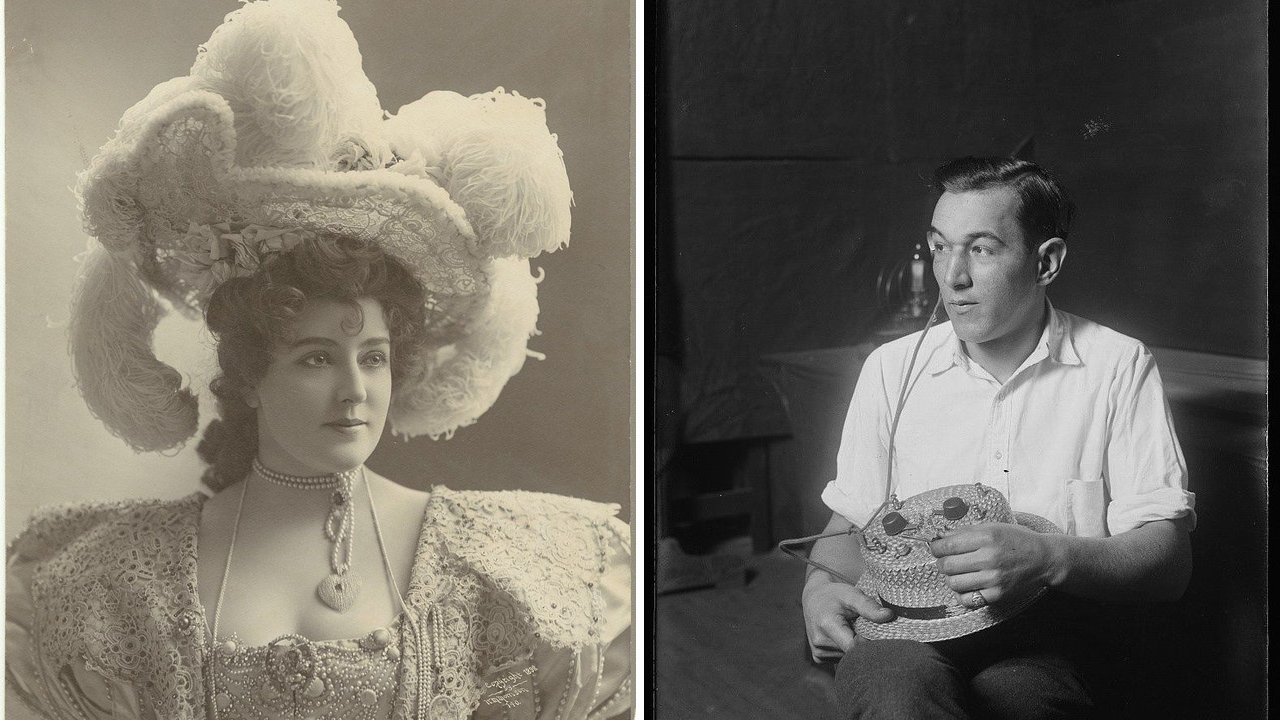
Stage star Lillian Russell posed in an enormous plumed hat for photographer William McKenzie Morrison in 1898. The feathers almost compete with the performer herself for attention, which helps explain why the portrait remains so arresting. This is the fashionable hat as spectacle, frozen in a formal studio photograph.
The straw hat with a built-in radio

At a Washington radio show sometime between 1921 and 1924, Harris & Ewing photographed a straw hat fitted with a radio set. The archive's original caption called it the latest spring style for men, apparently with a wink. Whether or not anyone wore it on the street, the device makes an unforgettable reminder that novelty gadgets and fashion have been colliding for more than a century.