
Before miniature golf became a familiar fixture of family entertainment centers, America's roadside courses were full of oversized creatures, miniature castles, and wonderfully peculiar inventions. Photographer John Margolies captured many of these colorful attractions during his travels across the country. These 30 vintage scenes reveal a playful side of American roadside culture, where even the obstacles had personality.
A sphinx guarding the putting green

At Wacky Golf in Myrtle Beach, South Carolina, an Egyptian-style sphinx brought a touch of ancient history to a decidedly American pastime. The combination was wonderfully improbable: a famous symbol of the ancient world standing beside a miniature golf course. It was the kind of roadside spectacle that made the game feel like an adventure before anyone picked up a putter.
When dinosaurs ruled Wacky Golf

A dinosaur was another of the attractions at Myrtle Beach's Wacky Golf. Prehistoric creatures were natural attention-grabbers for roadside businesses, especially when reproduced at a size that could impress a car full of children. The appeal had little to do with realistic paleontology and everything to do with having fun.
A desert cave in Myrtle Beach

Wacky Golf also featured a stone cave decorated with cactus imagery, bringing an imagined desert landscape to the South Carolina coast. Miniature golf designers rarely worried about keeping their themes geographically consistent. A visitor could encounter ancient Egypt, prehistoric creatures, and a desert hideaway without ever leaving the same course.
Sir Goony's prehistoric surprise

Sir Goony Golf on Independence Boulevard in Charlotte, North Carolina, featured a dinosaur that turned an ordinary roadside attraction into something much more memorable. These creatures gave miniature golf courses an immediate visual identity. Long after a round was forgotten, the giant dinosaur was probably the detail visitors remembered.
Pirates take over Old Pro Golf

At Old Pro Golf in Ocean City, Maryland, a pirate ship became part of the miniature golf scenery. The nautical theme was a natural fit for a coastal resort, although the elaborate setting went far beyond what was necessary for putting a golf ball. For families vacationing at the beach, the surroundings were often as entertaining as the game itself.
A shipwreck on the putting course

A ship-themed attraction at Jockey's Ridge in North Carolina continued the tradition of turning miniature golf into a make-believe expedition. A vessel normally associated with open water became a whimsical landmark on dry land. It was a simple way to make a small recreational space feel like an entirely different world.
A rocket ready for takeoff

A rocket-shaped feature at Vinson's miniature golf course brought the excitement of space exploration down to putting-green level. America's fascination with rockets and astronauts found its way into countless forms of popular design. At miniature golf courses, that enthusiasm could become a colorful obstacle rather than a museum exhibit.
A clown at the eighteenth hole

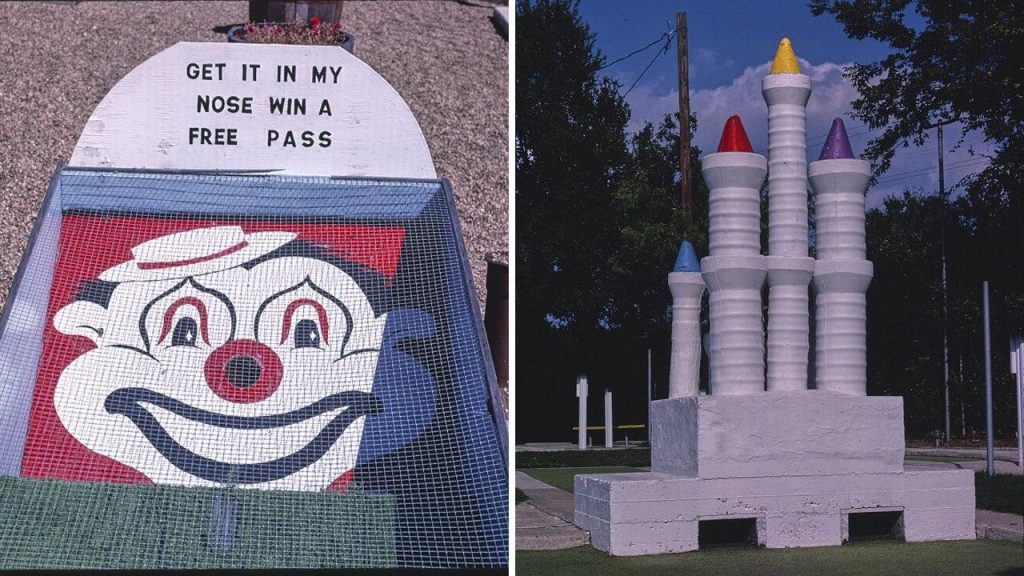
Cottonwood Corral in Yankton, South Dakota, featured a clown that added a carnival atmosphere to miniature golf. Oversized faces and comic figures were common ingredients in family-oriented roadside entertainment. Whether players loved clowns or found them a little unsettling, this was certainly an attraction with personality.
Peter Pan's little castle

Peter Pan Mini Golf on Barton Springs Road in Austin, Texas, featured a miniature castle that belonged more to a fairy tale than a traditional golf course. The building transformed a simple putting challenge into a small storybook scene. Attractions like this made the course feel playful even for visitors who were not especially interested in golf.
A peculiar collection of boxes

Another hole at Austin's Peter Pan Mini Golf used a collection of boxes as part of its unconventional design. Not every memorable obstacle needed to be a monster, castle, or giant animal. Sometimes an unusual arrangement of ordinary-looking shapes was enough to give a putting hole its own identity.
The windmill at Buckroe Beach

Few objects became more closely associated with miniature golf than the windmill. At Buckroe Beach in Virginia, this familiar structure gave the course a recognizable landmark. Windmills worked especially well as miniature golf scenery because their moving parts could turn an easy-looking shot into a test of timing.
A windmill beside Route 1

A miniature golf windmill along Route 1 reflected one of the enduring traditions of American roadside recreation. The structure was instantly recognizable, easy to understand, and visually inviting. Even people who had never played the course could probably imagine the challenge of sending a ball through its opening.
Another dinosaur by the highway

A dinosaur beside Route 1 offered motorists something more memorable than an ordinary advertisement. Giant roadside creatures belonged to a culture of attractions designed to catch the eye of passing travelers. A miniature golf course with its own dinosaur hardly needed a subtle sign to announce its presence.
Route 1's miniature space race

A rocket at a Route 1 miniature golf attraction added another layer of fantasy to the roadside landscape. By combining space-age imagery with a familiar family game, the course could promise something beyond a simple round of golf. It was a small example of how popular culture shaped American leisure spaces.
The unmistakable pink elephant

A large pink elephant was the sort of spectacle that could make drivers turn their heads before they even noticed the putting greens. Bright colors and oversized animals were reliable ingredients in roadside architecture. Subtlety was never really the point. The attraction needed to be seen, remembered, and talked about.
A whale far from the ocean floor

Stewart Beach in Galveston, Texas, featured a whale that brought marine life into the miniature golf experience. A large animal made a fitting attraction for a seaside recreational area. These imaginative designs allowed visitors to enjoy the visual excitement of an amusement park on the smaller scale of a putting course.
Jungleland's playful fountain

At Jungleland, a fountain helped create the impression of a miniature landscape rather than a conventional sports facility. Water features gave designers an opportunity to add movement, atmosphere, and another obstacle for players to negotiate. A modest putting course could suddenly feel like a tiny tropical retreat.
A lighthouse at Pelican Point

Pelican Point incorporated a lighthouse into its miniature golf scenery, borrowing one of the most recognizable structures along America's coastlines. Unlike a working lighthouse, this version existed to entertain rather than guide ships. It also offered players a landmark much more interesting than an ordinary numbered hole.
A miniature saloon in the West

CC's miniature golf course included a saloon-style structure that brought a little Old West imagery into the game. Western towns and frontier architecture were popular subjects for themed American attractions. On a putting course, the effect could be achieved with a small facade and a generous sense of imagination.
Rich's roadside putting attraction

Rich's miniature golf captured the appeal of a recreational stop designed for casual visitors rather than serious golfers. Courses like these became familiar features of American vacation areas and roadside entertainment districts. Their character came from the scenery, signs, and eccentric details surrounding the greens.
Fountain Valley's little windmill

The windmill at Fountain Valley offered another variation on miniature golf's best-known obstacle. Designers could take the same basic idea and give it a different shape, color, or setting. It is a reminder that much of the charm of vintage miniature golf came from the handmade-looking personalities of the structures.
A windmill on Jekyll Island

At Jekyll Island in Georgia, a windmill added a familiar touch of miniature golf tradition to a coastal getaway. These structures were practical visual markers for a pastime built around novelty. The challenge might have lasted only a moment, but the windmill made the hole recognizable in a photograph decades later.
Green Pines keeps the tradition alive

Green Pines featured a windmill that reflected the long-standing relationship between miniature golf and playful mechanical obstacles. A windmill could make even a short putting lane seem more involved than it really was. It also gave a course a cheerful, unmistakably old-fashioned appearance.
Blackbeard's miniature lighthouse

Blackbeard's miniature golf attraction used a lighthouse as part of its coastal adventure atmosphere. The structure fit naturally with pirate imagery and maritime themes. By borrowing familiar elements from seaside history, the course created a setting that was immediately recognizable and entertaining.
The windmill at Castle Amusement

Castle Amusement offered its own version of the miniature golf windmill, combining two enduring themes of roadside recreation: fantasy buildings and moving obstacles. Such features turned putting into a more theatrical activity. Players were not just aiming at a hole; they were navigating a miniature stage set.
Concrete scenery at Blackbeard's

Not every memorable part of a miniature golf course had to be a recognizable building or creature. Blackbeard's also featured sculpted concrete scenery that helped shape the miniature landscape. Such constructions allowed designers to create artificial terrain, winding routes, and a little visual drama on a limited piece of land.
Garden Golf's roadside castle

A castle at Garden Golf transformed a familiar recreational attraction into something resembling a tiny fantasy kingdom. Castle imagery was especially useful for mini-golf designers because towers and gateways could become eye-catching landmarks. Even a simple round felt more adventurous when the surroundings suggested a storybook setting.
A circus comes to miniature golf

Circus Circus used a lively entrance sign to establish an amusement-park mood before visitors reached the course itself. Roadside entertainment businesses often depended on bold signage to stand out from nearby attractions. A memorable entrance could become as recognizable as the obstacles waiting inside.
A tropical escape in miniature

Tropical Village brought an imagined vacation landscape to the miniature golf experience. Themed courses could offer palm trees, exotic scenery, and an atmosphere of escape without requiring a plane ticket. For American families on a road trip, this combination of leisure and playful fantasy was part of the appeal.
Goofy Golf's enormous sphinx

Goofy Golf on Panama City Beach's Route 98A in Florida featured a sphinx that brought an unexpected monument of ancient Egypt to the roadside. The attraction illustrates the anything-goes imagination of vintage miniature golf: familiar historical imagery recreated for pure fun. It is a fitting final image for a gallery celebrating America's wonderfully eccentric putting courses.