
Before a movie could light up a giant outdoor screen, a roadside sign had to catch the driver's eye. Across America, drive-in theaters turned ordinary highways into places of glowing letters, dramatic names, and promises of an evening under the stars. John Margolies photographed these landmarks from the 1970s into the 1990s, preserving both flashy marquees and quieter reminders of a once-familiar night out.
El Monte Drive-In, California

The El Monte Drive-In stood along Lower Azusa Road in Southern California. John Margolies photographed it in 1981, preserving a part of the theater's roadside identity that might otherwise have escaped the historical record. His image reminds us that drive-in design was not limited to neon lettering; the buildings and screens helped make these places recognizable, too.
Lakewood Drive-In, California

In 1981, Margolies photographed the Lakewood Drive-In on Carson Street. Drive-in theaters depended on being recognizable from the road, where their names competed with gas stations, diners, and passing traffic. This California location shows how closely outdoor moviegoing was tied to the everyday landscape of the automobile.
Van Nuys Drive-In, California

Roscoe Boulevard in Van Nuys had its own drive-in theater, captured by Margolies in 1981. A theater on a busy Los Angeles-area road needed to announce itself before drivers reached the entrance. What survives in the archive is a piece of neighborhood movie history, not just a reminder of Hollywood's films.
Tascosa Drive-In, Amarillo

The Tascosa Drive-In appeared near Northeast 24th Avenue and Dumas Drive in Amarillo, Texas. Margolies recorded a straight-on view in 1977, treating the theater's roadside presence as something worth preserving. In a city associated with long-distance driving, an outdoor movie theater belonged naturally to the roadside scene.
Trail Drive-In on Route 66

The Trail Drive-In in Amarillo occupied a particularly fitting address: Route 66. Margolies photographed it in 1977, when the famous highway still carried decades of roadside memories. A drive-in along that route offered travelers and locals a destination where the car remained part of the entertainment.
San Pedro Drive-In, Los Angeles

Margolies photographed the San Pedro Drive-In along Gaffey Street in Los Angeles in 1977. His record focuses on the theater as roadside architecture, the kind of structure that once signaled a night at the movies well before the previews began. It is a distinctly Southern California pairing of cars, open space, and cinema.
Terrace Drive-In, Bakersfield

The Terrace Drive-In stood on Terrace Way in Bakersfield, California. This archival photograph is especially useful for seeing the theater's physical design, rather than assuming every drive-in image must feature a glowing sign. Outdoor cinemas needed enormous screens as much as memorable names, and both became part of the roadside landscape.
Flamingo Drive-In, New Mexico

The Flamingo Drive-In had a sign on Dal Passo Road in Hobbs, New Mexico, which Margolies photographed in 1982. The name brings a little tropical imagination to a very different landscape. That contrast captures one of the pleasures of old roadside branding: a few words could make an ordinary turnoff feel like a destination.
Star-Lite Drive-In, North Dakota

On Route 85 in Minot, North Dakota, the Star-Lite Drive-In wore a name that was practically made for movies beneath the sky. Margolies documented its sign in 1987. Even in a still photograph, the words evoke headlights arriving at dusk and a screen waiting for darkness.
Skyway Auto Theatre, Ohio

Ashtabula, Ohio, had the Skyway Auto Theatre along Route 20. Margolies photographed its sign from a horizontal angle in 1977, and the old-fashioned 'Auto Theatre' wording is part of its appeal. It recalls an era when the novelty of watching a movie from your own car was worth putting right in the name.
Winchester Drive-In, Oklahoma City

The Winchester Drive-In's sign was still worth documenting in 1993, when Margolies photographed it on South Western Avenue in Oklahoma City. That date matters: this is a later record of a style associated with the drive-in boom, not necessarily a photograph from its peak. The sign remained a visible reminder of how outdoor theaters announced themselves.
Starlite Drive-In, Michigan

The Starlite Drive-In stood along Route 10 in Bay City, Michigan. Margolies photographed its sign in 1988, preserving another variation on one of drive-in culture's favorite ideas: watching movies under the stars. The name alone tells you what indoor theaters could not offer.
Airway Drive-In, Missouri

In Saint Ann, Missouri, the Airway Drive-In advertised itself along the road. Margolies documented the theater in 1988, long after drive-ins had become familiar fixtures of American leisure. Its aviation-inspired name hints at the exuberant naming habits of roadside businesses, where a little imagination could help an establishment stand out.
Grove Drive-In, Arkansas

The Grove Drive-In in Springdale, Arkansas, made it into Margolies's archive in 1984. The name sounds almost like a place for a picnic, which suited an entertainment format built around being outdoors. This is a reminder that drive-in moviegoing was as much about the setting and the shared outing as the feature on the screen.
Deer Lake Drive-In, Pennsylvania

The Deer Lake Drive-In was photographed near Orwigsburg, Pennsylvania. Unlike a downtown movie palace, a roadside theater had to be understood by people approaching in moving cars. Its appearance in the Margolies archive preserves a local landmark that might otherwise survive only in family stories and old movie listings.
Sunset Drive-In on Route 66

Amarillo had more than one memorable outdoor theater, including the Sunset Drive-In on West Ninth Street along Business Route 66. Margolies photographed this one in 1977. 'Sunset' was an especially apt name for a business whose main attraction traditionally began after the daylight faded.
Sunset Drive-In, Georgia

A second Sunset Drive-In appeared in Margolies's photographs from Moultrie, Georgia, in 1979. The repeated name is no accident in a broader cultural sense: sunset was the moment that turned a parking lot and screen into a movie theater. This Georgia example gives the familiar idea a distinctly local address.
Mid-way Drive-In, Kansas

The Mid-way Drive-In stood along Route 19 in Junction City, Kansas, when Margolies photographed it in 1977. Names like 'Mid-way' suggested an easy roadside stop, whether or not a theater was actually halfway between destinations. For moviegoers, the real appeal was stopping the car and staying awhile.
Fun-Lan Drive-In, Florida

Route 1 in Edgewater, Florida, was home to the Fun-Lan Drive-In, photographed in 1979. The playful name says plenty about the kind of evening the owners hoped to sell: more than just a film, it was a family outing or a date night. Roadside entertainment often began with a name that was impossible to overlook.
The Gay 90 Drive-In, Texas

The Gay 90 Drive-In stood along Route 90 in Del Rio, Texas, and Margolies photographed it in 1982. Its unusual name and numbered highway address gave passing drivers plenty to remember. It is an example of how deeply some drive-in identities were rooted in the roads that brought their customers to the gate.
Roulette Drive-In, Pennsylvania

Roulette, Pennsylvania, had a drive-in theater named for the town itself, along Route 6. Margolies photographed it in 1977. There is something particularly American about a small community having its own outdoor screen, with moviegoing folded into the same roads people traveled every day.
Sky View Drive-In, Oklahoma

The Sky View Drive-In appeared along Route 62 in Oklahoma City. Its name captured the difference between an enclosed auditorium and a movie watched through the windshield. In Margolies's photograph, the theater becomes part of a larger story about businesses that used the open sky as their selling point.
F Road Drive-In, San Antonio

The F Road Drive-In had an address on Fredericksburg Road in San Antonio, Texas. The spare, unusual name feels almost like a piece of directions rather than a traditional movie-theater title. Margolies's photograph preserves that local identity, one that would be easy to overlook in a history focused only on famous cinema chains.
Don Drive-In, Port Arthur

The Don Drive-In sat near the meeting of several numbered routes in Port Arthur, Texas. Margolies photographed it in 1979, recording another theater whose audience arrived by road instead of on foot. Its brief name is a contrast to the more fanciful Starlites and Sky Views elsewhere in the collection.
Mission Drive-In, California

In San Juan Capistrano, California, the Mission Drive-In borrowed a name closely associated with the region's history. Margolies photographed the theater in 1979. That local reference made it different from the countless drive-ins named after stars, skies, and sunsets, and gave the theater a recognizable identity of its own.
Trail Drive-In, San Antonio

San Antonio had a Trail Drive-In along Southwest Military Drive, photographed by Margolies in 1982. Despite sharing a name with the Amarillo theater, this was a separate Texas location. The repetition shows how certain words, especially ones suggesting travel and open roads, became a natural fit for drive-in movie branding.
Red Run Drive-In, Pennsylvania

The Red Run Drive-In was located along Route 16 in Rouzerville, Pennsylvania. Its name was tied to the local landscape rather than the stars or the movies themselves. Margolies's archival photograph keeps a piece of small-town entertainment history visible, even for readers who never visited the theater.
Compton Drive-In, California

On Rosecrans Avenue in Compton, California, the drive-in theater was part of a busy urban roadside world. Margolies photographed it as a place worth remembering in its own right. Outdoor movie theaters were not all remote country fields; they also belonged to the daily geography of metropolitan Los Angeles.
Top-Hi Drive-In, Washington

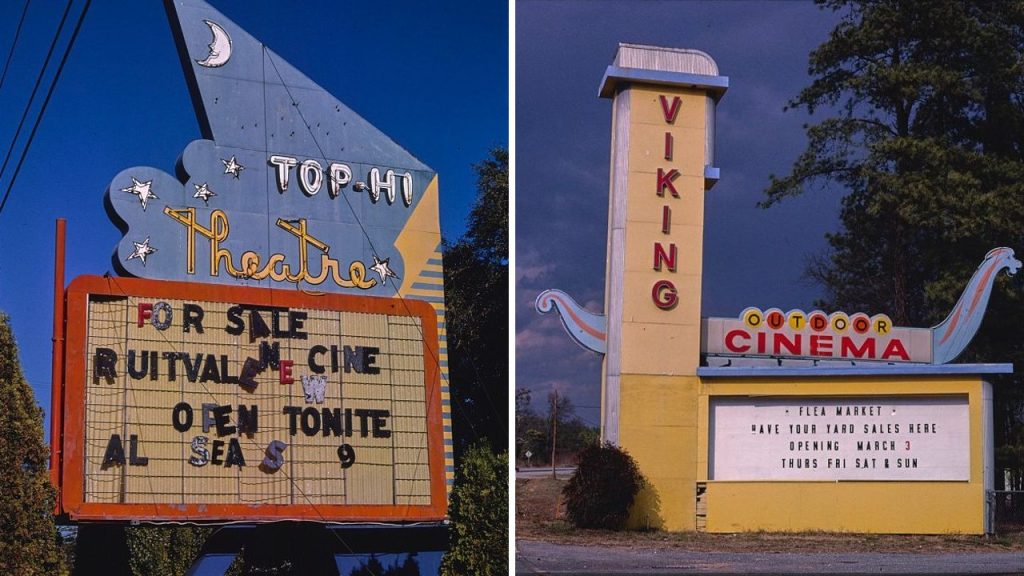
The Top-Hi Drive-In's sign stood near Route 97 in Toppenish, Washington. Its short, distinctive name is the sort of roadside lettering that could lodge in a driver's memory after a single glance. Margolies preserved it as one of the many individual signs that gave American drive-ins their character.
Viking Drive-In, South Carolina

Margolies photographed the Viking Drive-In sign along Route 29 in Anderson, South Carolina, in 1988. The Library of Congress describes this particular view as having a darker sky, a fitting backdrop for a theater associated with movies after sundown. It is a strong closing reminder that the sign often set the mood long before anyone watched the screen.