Before cameras could capture every moment of the Civil War, artists followed armies into camps, onto battlefields, and through ruined towns with pencils and sketchbooks. Their drawings preserved more than military movements. They recorded the exhaustion, humor, fear, and ordinary routines of people living through America’s deadliest war.
The Battle of Peachtree Creek, 1864

On July 20, 1864, Confederate forces attacked Union troops near Peachtree Creek during the Atlanta Campaign. Adolph Metzner, an officer in the 32nd Indiana Infantry, recorded the fighting in a drawing that brings the distant military history of the campaign closer to the men experiencing it. The battle ended in a Confederate defeat, bringing Union forces another step toward Atlanta.
Three comrades in Huntsville, Alabama

In July 1862, Metzner drew himself alongside Lieutenant Louis von Trebra and Jacob Labinsky in Huntsville, Alabama. All three were connected to the 32nd Indiana, a regiment with a strong German immigrant presence. Their appearance together is a reminder that the Union Army included men whose lives and experiences extended far beyond the United States.
Lost on the field of Chickamauga

The Battle of Chickamauga in September 1863 was one of the Civil War’s bloodiest clashes. Metzner’s drawing titled ‘Lost on the field of Chickamauga’ offers a more personal perspective than a map covered in arrows and troop positions. For soldiers caught amid confusing movements, smoke, and unfamiliar terrain, simply finding their way could become a struggle.
A quiet view of Green River

Not every surviving Civil War drawing shows a battlefield. Metzner’s view of Green River captures a place associated with Union military operations in Kentucky. Landscapes like this mattered enormously to campaigning armies, which depended on rivers, roads, and crossings to move supplies and troops. The setting also reminds us how much of military life unfolded away from actual combat.
Lieutenant Colonel Henry von Trebra

Metzner’s portrait of Lieutenant Colonel Henry von Trebra dates to August 26, 1861, early in the conflict. Von Trebra served with the 32nd Indiana Infantry, among the Union regiments closely associated with German American volunteers. Personal portraits gave these officers a presence that official military reports rarely conveyed. They were individuals as well as names in regimental histories.
Jacob Labinsky, the camp comedian

Jacob Labinsky of Company A earned the nickname ‘The Camp Comedian,’ according to Metzner’s drawing. That small detail opens a window onto a side of army life often overlooked in accounts of battles and generals. Humor offered soldiers a way to pass long hours and endure difficult circumstances. Even in wartime, personality and laughter had their place in camp.
Chicken thieves face discipline

At Camp Nevin, Kentucky, in November 1861, Metzner recorded soldiers being punished for stealing chickens under General Alexander McDowell McCook. The episode shows an army dealing with an ordinary problem: keeping hungry men disciplined while stationed near civilian communities. Wartime sketches could be surprisingly candid about behavior that formal military portraits preferred to ignore.
General Willich’s mountain quarters

Metzner recorded General August Willich’s quarters near Lookout Mountain, Tennessee. Willich, a German-born Union commander, became closely associated with troops that included many German immigrants. The drawing turns attention away from battlefield heroics and toward the places where officers worked and lived. Command was conducted from temporary quarters as well as the front lines.
Frank Erdelmeyer at Stones River

Metzner’s drawing places Lieutenant Colonel Francis ‘Frank’ Erdelmeyer at Stones River, Tennessee, in January 1863. The battle, fought around the turn of the new year, produced enormous casualties on both sides. Portraits made during campaigns provide another way to remember those events. Instead of showing an army as a single force, they preserve the individuals who served within it.
The men who kept the army supplied

Military life depended on far more than infantrymen carrying rifles. Metzner’s drawing identifying Dr. Charles Fischer and Commissary Sergeant Emanuel Wassenick draws attention to the medical and supply personnel working behind the lines. Food, treatment, equipment, and organization were essential to keeping a regiment functioning. Their work was less celebrated than combat, but the army could not operate without it.
A funeral at Camp Nevin

Metzner documented the funeral of Private Xavier Blodier at Camp Nevin, Kentucky. Unlike a panoramic battle scene, this drawing focuses attention on the loss of one soldier and the community left to mourn him. Death was a constant presence during the Civil War, even away from famous engagements. Such images record how soldiers confronted grief within the routines of military service.
An officer remembered in November 1862

Another Metzner portrait depicts Lieutenant Colonel Francis ‘Frank’ Erdelmeyer on November 14, 1862. Drawings like this preserved likenesses at a time when men could spend months away from home. They also offer historians visual evidence of the people who served in individual units. Behind every regiment listed in an official report were hundreds of distinct lives.
An outpost in the spring of 1862

This April 1862 drawing identifies Captain Francis Erdelmeyer and Private Jacob Labinsky. It brings together two very different ranks within the same military world. The army operated through strict hierarchies, yet officers and enlisted men shared many of the same uncertain movements and difficult living conditions. Metzner’s attention to named companions gives the regiment a personal history.
The Atlanta Campaign begins

Metzner dated this drawing to May 10, 1864, near the beginning of the Atlanta Campaign. General William T. Sherman’s Union forces were advancing through Georgia against Confederate armies defending the approaches to Atlanta. The campaign would involve months of fighting, maneuvering, and pressure on transportation lines. A field artist’s drawing captures one moment in that much larger operation.
A glimpse of the Texas Rangers

Metzner’s drawing titled ‘Texas Rangers’ brings another recognizable name from nineteenth-century American history into the Civil War record. Mounted soldiers played important roles in reconnaissance, communication, raids, and screening army movements. Their wartime activities were more complicated than the romantic image of lone horsemen familiar from later Western stories.
Two doctors at Camp Wood

Dr. Charles Fischer and Dr. Jean Allard Janson appear in a Metzner drawing set at Camp Wood, Kentucky. Medical officers faced enormous challenges as armies moved through unfamiliar territory and lived in crowded conditions. Illness claimed many lives during the Civil War, making routine medical care as important as treatment following battles. The presence of these doctors highlights another essential part of the military experience.
Lookout Mountain in the fall of 1863

Lookout Mountain rises above the Chattanooga area, which became a crucial strategic location in 1863. Metzner’s drawing preserves the landscape during a season of intense military activity. The mountain’s steep terrain shaped how soldiers and commanders understood the ground around them. Drawings of places like this help explain why geography mattered so much in Civil War campaigns.
The company cook and his officer

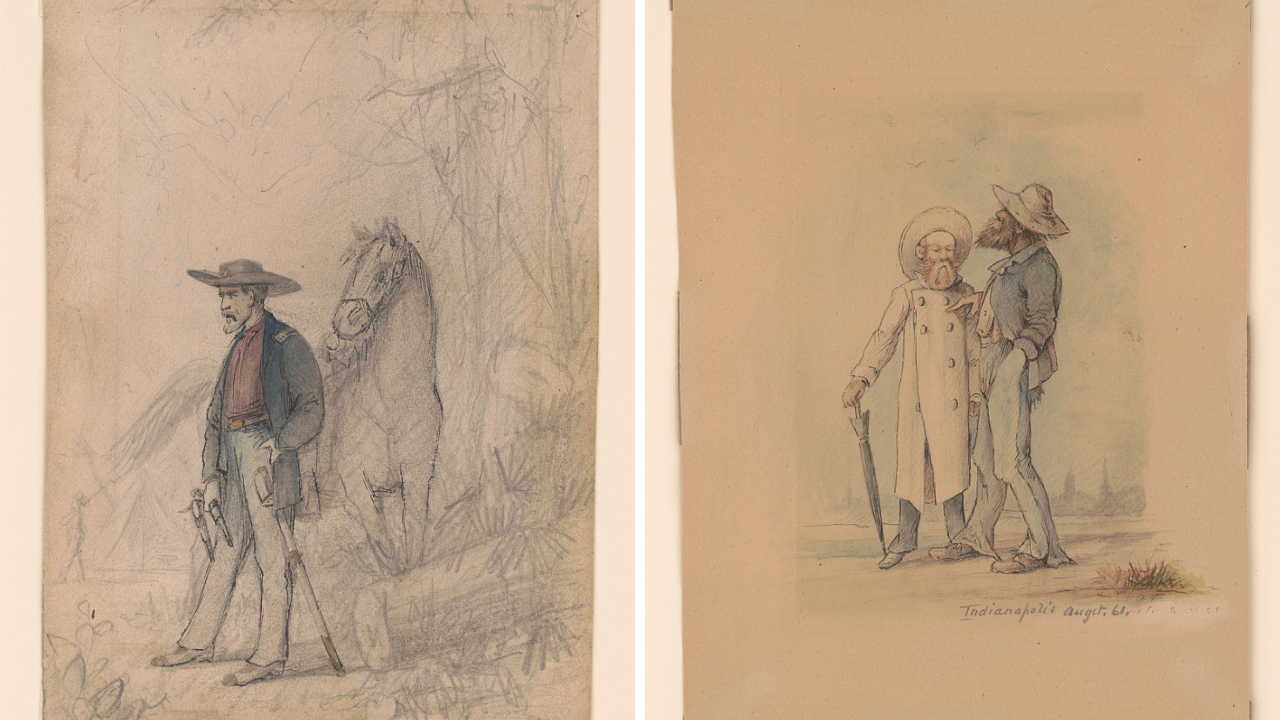
In August 1861, Metzner drew Hans, the cook of Company A, alongside Henry von Trebra in Indianapolis. The unusual pairing makes this one of the collection’s most revealing glimpses of early regimental life. An army might be organized around military ranks, but its daily existence depended on practical work such as preparing meals. Hans belonged to that less celebrated world of service.
The first Confederate prisoners

Metzner’s drawing of the first Confederate prisoners and General Willich at Green River, Kentucky, records a different kind of wartime encounter. Captured soldiers became part of the daily reality of military campaigns. Their presence raised immediate questions about custody, transportation, and treatment. For the men who saw them, prisoners also represented the enemy in an unexpectedly personal form.
The human cost of the war

Metzner gave this drawing the stark title ‘Casualties of the War.’ The phrase encompasses losses that stretched far beyond the battlefield, affecting soldiers, families, and entire communities. Civil War art often returned to this human dimension, reminding viewers that military victories and defeats came at an enormous price. Here, the artist’s chosen subject directs our attention to the consequences rather than the spectacle of conflict.
Captured by Morgan’s cavalry

Metzner recorded an episode involving capture by Morgan’s cavalry at La Vergne, Tennessee, in 1863. Confederate cavalry under John Hunt Morgan became well known for raids that disrupted Union movement and communications. For an individual soldier, an encounter with mounted raiders could abruptly change the course of a campaign. The drawing places that uncertainty within the experience of the men involved.
The men of the 32nd Indiana

The 32nd Indiana Volunteer Infantry was particularly notable for its German American membership. Metzner’s drawing of its troops preserves a visual record of men whose backgrounds reflected the immigrant communities supporting the Union cause. Their service was part of a broader struggle over the future of the United States. Regimental drawings help preserve that history in faces, uniforms, and shared identity.
The officer who would not stop snoring

In one of his more humorous drawings, Metzner records an officer asking an orderly who is snoring so loudly. The answer is wonderfully awkward: ‘Your First Lieutenant!’ The joke offers a rare moment of comedy amid the collection’s scenes of campaigning and war. Soldiers endured hardship, but they also teased one another and found humor in the absurdities of close quarters.
Edwin Forbes sketches Antietam

On September 17, 1862, Edwin Forbes recorded the Battle of Antietam, also known as Sharpsburg. His drawing was made from a position north of Antietam Creek and depicts the action of General Edwin Sumner’s corps against Confederate positions. Antietam became the bloodiest single day in American military history. Forbes’s battlefield view is especially valuable because it records how the landscape and fighting appeared to a contemporary observer.
Blacksmiths serving the army

This drawing, set near Tipton, Missouri, shows soldiers engaged in blacksmithing work, including shoeing horses and tending a fire. The artist worked under the name A. S. Leclerc, a pseudonym associated with Alexander Simplot. Horses remained essential for cavalry, artillery, and transportation, and their care required constant attention. Scenes like this reveal the labor that made military movement possible.
A mule driver in 1863

Edwin Forbes dated his drawing ‘A mule driver’ to November 23, 1863. Mule teams helped move the immense quantities of food, ammunition, and equipment required by Civil War armies. Their drivers worked in difficult conditions, often traveling on muddy roads and over rough ground. While generals planned campaigns, the movement of supplies depended on people whose names rarely entered the history books.
Alfred Waud studies the soldiers

Alfred R. Waud became one of the Civil War’s most important visual correspondents, sending sketches of military life and campaigning to the illustrated press. His studies of soldiers preserve details that might seem too ordinary for a grand historical painting. Clothing, posture, and equipment could all become subjects worth recording. Those observations remain part of what makes eyewitness wartime drawings valuable today.
The uniforms of the Army of the Potomac

Waud’s uniform studies document the different ranks and roles within the Union Army of the Potomac. His notes identify officers, enlisted men, musicians, and specialized military personnel, alongside details of garments and equipment. Such sketches were useful references for an artist trying to depict army life accurately. They now provide historians with a remarkable record of how Civil War soldiers were dressed.
The front lines near Petersburg

The prolonged struggle around Petersburg, Virginia, transformed parts of the landscape into networks of trenches, fortifications, and opposing military positions. Alfred Waud’s work offers a contemporary artist’s view of this phase of the war. Rather than the swift movements of earlier campaigns, Petersburg became associated with exhausting positional warfare. Its drawings help bring that changed battlefield experience into focus.