Ever look at your house or the phone in your hand and wonder how we got here so fast? One fact we can’t deny us that History isn’t just about dusty textbooks, but the story of how our lives changed from handwritten letters to instant messages. Thinking about that, we have gathered the big moments that pushed us forward, from old laws to the tech in your pocket. It is a wild ride through the breakthroughs that truly built our world today.
Magna carta

King John was forced to sign this in 1215, which meant that even a king had to follow the law and eventually gave us the ideas of fairness and justice we use in our courts today.
The printing press

In the mid-1400s, Johannes Gutenberg built a machine that let people print books quickly, which finally took knowledge out of the hands of the elite and gave it to everyone for the very first time.
Declaration of independence

A new nation was born in 1776 when a group of colonies decided to break away from British rule, setting a standard for democracy that people around the whole world still discuss and value.
Industrial revolution

Factories and steam power began replacing hand tools in the late 1700s, moving families from quiet farms into busy cities and starting the fast-paced lifestyle we all live in now.
Light bulb

Thomas Edison and his team developed a practical electric light in 1879, which effectively doubled the productive hours of the day and changed how we build our homes and modern cities.
First automobile

Karl Benz built the first true car in 1886, which eventually replaced the old horse and buggy and allowed people to live and travel much further away from their places of work.
Wright brothers flight

Air travel became a reality in 1903 because two brothers from Ohio managed to get a powered plane off the ground, a short trip that eventually made our world feel much smaller.
Penicillin

Alexander Fleming accidentally found a special mold in 1928 that killed bacteria, turning once-scary infections into simple problems that a routine visit to the doctor could easily fix.
Great depression

The entire world economy crashed in 1929, leading to years of hardship that forced governments to create safety nets like Social Security to make sure people were never that vulnerable again.
First computer

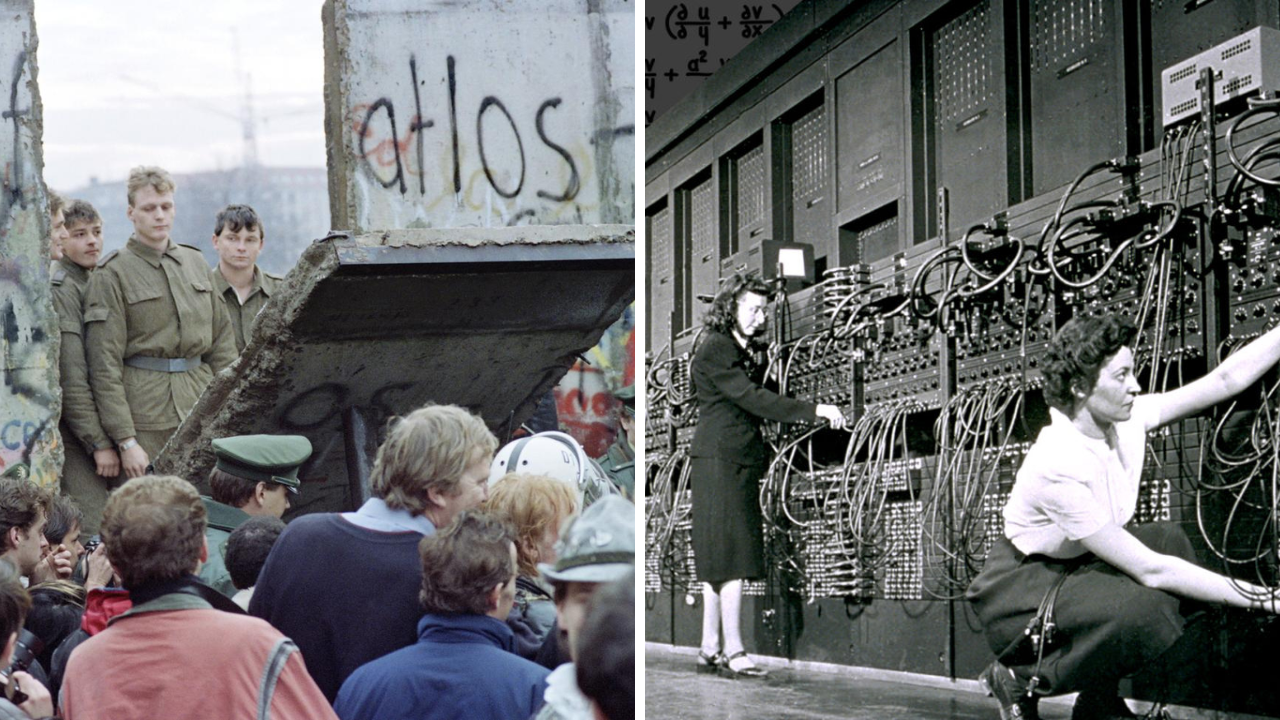
Electronic computing began with massive machines like ENIAC in the 1940s, which were as big as a room but paved the way for the portable laptops and tablets we rely on for almost every task now.
Moon landing

NASA proved humans could actually leave our planet in 1969 when Neil Armstrong stepped onto the lunar surface, showing everyone what happens when science and ambition work together.
First digital camera

An engineer at Kodak built the first digital camera in 1975, starting a slow movement that eventually changed how we record every single moment of our lives instantly without film.
Fall of the Berlin wall

The Cold War began to end in 1989 when this concrete barrier finally came down, reuniting a divided Germany and bringing a new sense of hope for freedom across the entire continent.
World Wide Web

Tim Berners-Lee changed how we share information in 1990 by creating the web, which turned the internet from a niche research tool into something that every person on earth uses every day.
Hubble space telescope

We got our first clear look at distant galaxies in 1990 after this telescope was launched, providing images that helped astronomers figure out how old and large our universe actually is.
End of apartheid

Nelson Mandela helped lead South Africa to its first multiracial election in 1994, showing everyone that even the most stubborn systems of racism can be dismantled with enough courage.
The 9/11

Global politics and security changed overnight in 2001 after the attacks on the United States, leading to a decade of war and new travel rules that we still deal with at every airport.
First smartphone

The way we interact with the world was fundamentally changed in 2007 when the first iPhone launched, putting a powerful computer and a high-quality camera right into our pockets for constant connection.
mRNA vaccines

Medical history was made in 2020 when researchers used mRNA technology to develop a vaccine in record time, proving we could react to global health threats much faster than we ever thought.
Commercial space flight

Space is no longer just for governments now that private companies are launching rockets, a shift from the 2020s that could eventually lead to people living and working on other planets. Can you imagine?
Rise of AI

Back to the present and looking to the future, machines can now write and create art thanks to the rise of advanced AI in 2022, an event that is forcing us to rethink what it actually means to be creative and productive in the modern age. How do you feel about AI?