More than any other art form, photography has a decisive ability to transport the viewer to a particular place and moment. Check out 30 of the most famous photos in the history of photography.
1. Bruce McCandless Floating Untethered In Space

Imagine skydiving and the chute fails, but instead of having a couple of minutes to contemplate your fate as the ground rapidly approaches, you have hours as you slowly drift off into space.
2. The First Hubble Deep Field

This is an image of a small region in the constellation Ursa Major, constructed from a series of observations by the Hubble Space Telescope. It covers an area of about 2.6 arcminutes on a side, about one 24-millionth of the whole sky, which is equivalent in angular size to a tennis ball at a distance of 100 metres.
3. Pale Blue Dot

This picture of Earth was taken on February 14, 1990, by the Voyager 1 space probe from an unprecedented distance of approximately 6 billion kilometers (3.7 billion miles, 40.5 AU), as part of that day’s Family Portrait series of images of the Solar System. In the photograph, Earth’s apparent size is less than a pixel.
4. Zbigniew Religa

This is Religa, a Polish cardiac surgeon and politician, after the first 24 hours of a heart transplant operation. The most impressive thing is that the patient outlived him.
5. A Nuclear Blast A Fraction Of A Second After It Detonated

This is a picture of a nuclear blast a fraction of a second after it detonated. This was taken by Harold Eugene Edgerton.
6. German Soldiers React To Footage Of Concentration Camps

The Allies’ policy of ‘denazification’ included a form of rehabilitation where German soldiers were forced to watch a film about a concentration camp. Turning the camera from the footage onto the audience, you need only look at their faces to feel their grief and shame.
7. Saturn

The Earth is visible, too. The bright spot on the left, that’s us. This is the modern equivalent of the pale blue dot.
8. Pillars Of Creation

This is a photograph taken by the Hubble Space Telescope of elephant trunks of interstellar gas and dust in the Eagle Nebula, in the Serpens constellation, some 6,500–7,000 light-years from Earth. These elephant trunks had been discovered by John Charles Duncan in 1920 on a plate made with the Mount Wilson Observatory 60-inch telescope.
9. Nagasaki From Ground Level

The bomb exploded 500 meters above Matsuyama-machi in the northern part of the city, 3 km. away from its primary target. A terrible image.
10. D-Day

That was the codename for the Allied invasion of Normandy, France, on June 6, 1944, during World War II. This is known as the largest seaborne invasion in history, involving the land, air, and sea forces of the Allies.
11. August Landmesser, The Man Who Refused Salute

He was a worker at the Blohm+Voss shipyard in Hamburg, Germany. He is known as the possible identity of a man appearing in a 1936 photograph, conspicuously refusing to perform the Nazi salute with the other workers. Landmesser had run afoul of the Nazi Party over his unlawful relationship with Irma Eckler, a Jewish woman.
12. The Last Atlas Lion

The last known wild Atlas lion was killed in Morocco in 1922. The last recorded sighting of a wild Barbary lion was in 1942, near Tizi n’Tichka in Morocco. The Barbary lion is now extinct in the wild.
13. The Boulevard Du Temple

The Boulevard du Temple, a daguerreotype made by Louis Daguerre in 1838, is generally accepted as the earliest photograph to include people.
14. The Blue Marble

This is NASA’s most popular image in the entire archive and is credited with helping to kick off the environmental movement. But what do you think?
15. An Atom

The visible part is many trillions of trillions times bigger than the atom itself. You are seeing a long exposure of many photons emitted from the atom itself. So that dot is not anything like the size it is in real life.
16. Big Jay Mcneely, Los Angeles Olympic Auditorium, 1951

It doesn’t seem that the name of the song was documented when this photo was taken. But his audience reacted this way commonly during his performances.
17. American Civil War Veteran Posing With A Military Jet

Many people have a soft spot for this picture of an American Civil War veteran posing with a military jet. It really shows the incredible progress made in the space of a lifetime.
18. Lunch Atop A Skyscraper

We really like this one picture where workers in New York are doing construction on a skyscraper, and they’re all sitting on this giant steel beam that’s just hanging hundreds of feet in the air. It’s called Lunch Atop a Skyscraper.
19. Two Engineers Hugging Each Other, Knowing That They’re Going To Die

In 2013, two engineers shared a hug atop a burning wind turbine in the Netherlands. They probably they took off their harnesses when they got in the nacelle (the part they are standing on is the cover of the nacelle), which sadly is common practice in the industry.
20. NASA’s Webb Reveal Of Cosmic Cliffs, Glittering Landscape of Star Birth

This landscape of “mountains” and “valleys” speckled with glittering stars is actually the edge of a nearby, young, star-forming region called NGC 3324 in the Carina Nebula. Captured in infrared light by NASA’s new James Webb Space Telescope, this image reveals for the first time previously invisible areas of star birth.
21. The Photo That Changed the Face Of Aids

The look the father has on his face. His world changed for the worse that day. This is so sad.
22. Omayra Sánchez Garzón

Omara was a Colombian girl who was trapped and killed by a landslide when she was 13 years old. The landslide was caused by the 1985 eruption of the volcano Nevado del Ruiz in Armero, Tolima. Volcanic debris mixed with ice to form massive lahars (volcanically induced mudflows, landslides, and debris flows), which rushed into the river valleys below the mountain, killing about 25,000 people and destroying Armero and 13 other villages.
23. Mars Sunset

This image blew our minds. Martian sunsets typically stand out for their distinctive blue color. Fine dust in the atmosphere permits blue light to penetrate the atmosphere more efficiently than colors with longer wavelengths.
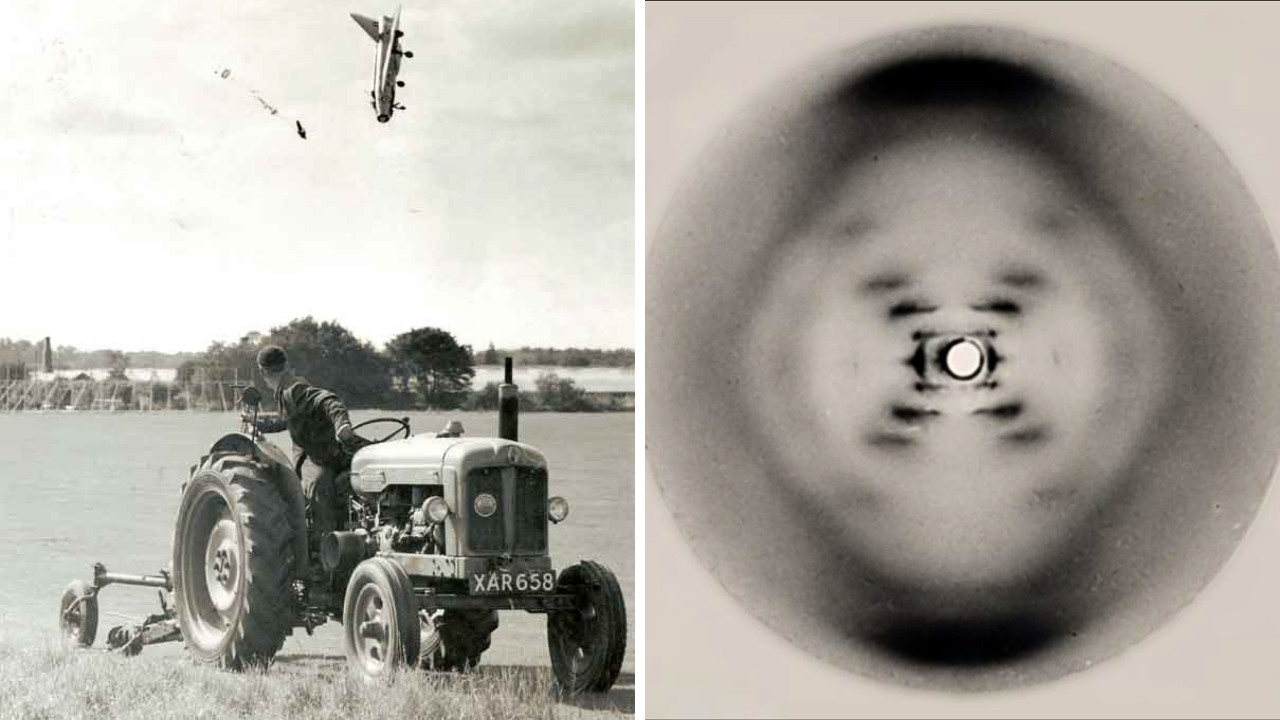
24. Photo 51, The First Photo Showing The Structure Of DNA

This image was taken by Rosalind Franklin in 1952 and shows the X-ray diffraction pattern of DNA, not the DNA itself. The pattern was used to deduce the helical nature of DNA.
25. St. Paul’s Survives

This is a photograph taken in London during the night air raid of 29–30 December 1940, the 114th night of the Blitz of World War II. It shows St. Paul’s Cathedral, illuminated by fires and surrounded by the smoke of burning buildings. It was taken by photographer Herbert Mason.
26. A Plane Crash

We think this photo of a plane crash is one of the best we have seen. Desvastating.
27. Frans Lanting, Ghost Trees

This has to be the wildest photo I have seen. We have had it engrained in our heads since the first time we saw it. It looks like a painting, but it is not.
28. Earthrise

This is a photograph of Earth and part of the Moon’s surface that was taken from lunar orbit by astronaut William Anders on December 24, 1968, during the Apollo 8 mission. Nature photographer Galen Rowell described it as “the most influential environmental photograph ever taken”.
29. Virunga Ranger With Gorilla

André Bauma is a park ranger at Virunga National Park who has cared for orphaned mountain gorillas since 2007, including Ndakasi, who lost her mother to armed militants. André described Ndakasi as a loving and intelligent gorilla whose survival story is deeply tied to the park’s history.
30. Fifth Solvay Conference

Auguste Piccard, Émile Henriot, Paul Ehrenfest, Édouard Herzen, Théophile de Donder, Erwin Schrödinger, JE Verschaffelt, Wolfgang Pauli, Werner Heisenberg, Ralph Fowler, Léon Brillouin. Peter Debye, Martin Knudsen, William Lawrence Bragg, Hendrik Anthony Kramers, Paul Dirac, Arthur Compton, Louis de Broglie, Max Born, Niels Bohr. And the list goes on…