Throughout history, shipwrecks have captured the world’s attention with stories of tragedy, heroism, mystery, and sometimes sheer bad luck. Some changed maritime laws, others sparked massive rescue efforts, and a few remain famous generations later. Here are 29 shipwrecks that shocked the world.
RMS Titanic (1912)

The most famous shipwreck in history began on its very first voyage from Southampton to New York. After striking an iceberg on April 14, 1912, the luxury liner sank in less than three hours. More than 1,500 people died in the freezing North Atlantic, and the disaster permanently changed maritime safety laws around the world.
MV Wilhelm Gustloff (1945)

While the Titanic gets most of the attention, the Wilhelm Gustloff remains the deadliest shipwreck ever recorded. Packed with German civilians and military personnel fleeing the advancing Soviet Army, it was torpedoed in the Baltic Sea during World War II. Roughly 9,400 people lost their lives, making it one of history’s greatest maritime tragedies.
HMS Erebus & HMS Terror (1848)

Sir John Franklin’s expedition set out to conquer the Northwest Passage but disappeared into the Arctic. Both ships became trapped in ice for years before the crews abandoned them. None of the 129 men survived. The mystery fascinated historians for generations until the wrecks were finally discovered in the 21st century.
USS Arizona (1941)

During Japan’s attack on Pearl Harbor, a bomb ignited the Arizona’s ammunition magazines. The resulting explosion destroyed the battleship in seconds and killed 1,177 sailors and marines. Today, the wreck remains beneath the memorial in Hawaii, where oil still slowly leaks from the ship more than 80 years later.
RMS Lusitania (1915)

When a German submarine torpedoed the Lusitania off Ireland, the ship sank in only 18 minutes. Nearly 1,200 people died, including 128 Americans. Although the United States did not immediately enter World War I, the sinking dramatically shifted public opinion against Germany.
Mary Rose (1545)

King Henry VIII watched in disbelief as one of England’s greatest warships sank during battle. The Mary Rose likely took on water through open gun ports while turning. Its recovery in 1982 became one of the most ambitious marine archaeology projects ever attempted.
Vasa (1628)

Sweden’s prized warship sailed less than a mile before disaster struck. Built with too much weight high above the waterline, the Vasa tipped over during a mild breeze and sank in front of stunned spectators. Remarkably, the vessel was recovered almost intact 333 years later.
MV Doña Paz (1987)

The Doña Paz collided with the oil tanker Vector in Philippine waters. Fuel spread across the sea and ignited, trapping thousands of passengers in a floating inferno. An estimated 4,386 people died, making it the deadliest peacetime maritime disaster ever recorded.
Bismarck (1941)

Germany’s most powerful battleship became the target of one of history’s greatest naval hunts after sinking HMS Hood. After days of pursuit, British forces crippled the ship and overwhelmed it with gunfire. More than 2,000 crew members went down with the vessel.
Andrea Doria (1956)

Heavy fog in Massachusetts led to a collision between the Andrea Doria and the Swedish liner Stockholm. Although the ship eventually sank, an extraordinary rescue effort saved more than 1,600 people. The dramatic event unfolded in front of television cameras and captivated the public.
SS Sultana (1865)

Only days after the American Civil War ended, the overcrowded Sultana suffered a catastrophic boiler explosion on the Mississippi River. Roughly 1,800 people died, making it the deadliest maritime disaster in U.S. history, yet it was largely overshadowed by the assassination of President Abraham Lincoln occurring around the same time.
SS Edmund Fitzgerald (1975)

The massive Great Lakes freighter vanished during a violent November storm. All 29 crew members were lost, and the ship never sent a distress call. Its mysterious final moments became legendary thanks to Gordon Lightfoot’s famous ballad.
Antikythera Wreck (c. 70–60 BC)

This ancient cargo ship carried luxury goods, statues, and one of archaeology’s greatest discoveries. Hidden among the wreckage was the Antikythera Mechanism, an astonishingly advanced device often described as the world’s first analog computer.
Costa Concordia (2012)

The captain intentionally sailed close to shore to perform a dramatic salute for onlookers. Instead, the ship struck rocks and partially capsized. Images of the giant cruise ship lying on its side became some of the most recognizable disaster photographs of the modern era.
HMS Endurance (1915)

Shackleton’s ship never completed its Antarctic mission. Crushed by sea ice, the Endurance slowly sank beneath the frozen ocean. The survival story that followed became one of the greatest leadership and endurance tales ever recorded.
RMS Republic (1909)

The Republic became famous for proving the value of wireless communication at sea. Its distress calls allowed nearby vessels to rescue nearly everyone aboard, demonstrating how radio technology could save lives long before the Titanic disaster.
Batavia (1629)

The sinking itself was only the beginning. After survivors reached nearby islands, a brutal mutiny erupted. More than 100 people were murdered by fellow survivors before the ringleaders were finally defeated, creating one of the darkest survival stories in maritime history.
SS Central America (1857)
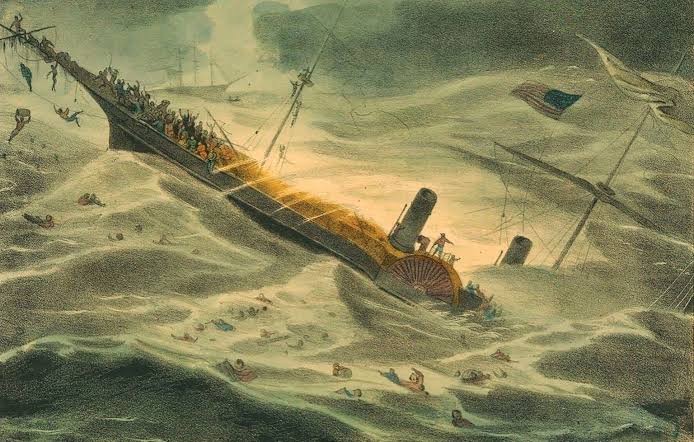
Nicknamed the “Ship of Gold,” this steamer carried enormous quantities of California gold when it sank during a hurricane. The loss contributed to a major financial panic in the United States and turned the wreck into one of the most sought-after treasure sites ever discovered.
Flor do Mar (1511)

The Flor do Mar was carrying a legendary treasure from the conquest of Malacca when it was destroyed in a storm. Centuries later, treasure hunters still search for its cargo, which could be worth billions if recovered.
Mary Celeste (1872)

The Mary Celeste never technically wrecked, but its mystery is unmatched. The ship was found drifting with food supplies, cargo, and personal belongings intact. The crew had vanished without explanation, inspiring endless theories involving pirates, mutiny, and even the supernatural.
Empress of Ireland (1914)

Often overshadowed by the Titanic, this Canadian disaster actually claimed over 1,000 lives. The ship sank in only 14 minutes after colliding with another vessel in dense fog, leaving passengers little time to escape.
USS Indianapolis (1945)

After secretly delivering parts for the atomic bomb, the Indianapolis was torpedoed in the Pacific. Hundreds of survivors spent four days in shark-infested waters waiting for rescue. Only 316 men survived one of the most harrowing ordeals in naval history.
Whydah Gally (1717)

Captured by pirate captain Black Sam Bellamy, the Whydah became one of the richest pirate ships ever to sail. A storm wrecked it off Cape Cod, and the discovery of its remains centuries later provided rare physical evidence of the Golden Age of Piracy.
HMS Birkenhead (1852)

When the ship struck rocks off South Africa, soldiers calmly stood in formation while women and children boarded lifeboats. Their sacrifice became legendary and helped establish the famous maritime tradition of “women and children first.”
SS Republic (1865)

Loaded with gold and silver coins, the SS Republic sank during a hurricane. The wreck remained hidden for nearly 140 years before being discovered, yielding one of the richest treasure recoveries in American history.
RMS Carpathia (1918)

The Carpathia earned worldwide admiration for rescuing Titanic survivors. Six years later, however, the heroic vessel met its own fate when a German submarine torpedoed it during World War I.
Nuestra Señora de Atocha (1622)

A hurricane destroyed this treasure-laden Spanish galleon near the Florida Keys. After a search lasting 16 years, treasure hunter Mel Fisher finally located the wreck and recovered one of the greatest treasure hauls ever found underwater.
San José (1708)

The San José exploded during a battle with British warships while carrying enormous quantities of gold, silver, and emeralds. Its discovery in 2015 sparked international disputes because the treasure is believed to be worth billions of dollars.
SS President Coolidge (1942)

The President Coolidge accidentally struck friendly mines while entering a harbor during World War II. Thanks to quick decisions by the captain, more than 5,000 troops escaped safely. Today, the wreck is one of the world’s most famous recreational dive sites.