

Six hundred million people watched the first moon landing on television. Here is what they did not show you.
1. The Word Literally Means “Star Sailor”

The term astronaut comes from the ancient Greek words “astron” and “nautes,” meaning star and sailor. The Russians went a different direction: cosmonaut translates to “universe sailor.” China’s taikonauts take it from “taikong,” meaning space or cosmos. Three countries, three words for essentially the same job, each reflecting a slightly different idea of what the person doing it is sailing through.
2. They Grow Up To Two Inches Taller In Space

Without gravity compressing the spine, the discs between vertebrae decompress and expand, making astronauts temporarily taller by up to three percent of their height. For an average adult, that is roughly one to two inches. The effect reverses within a few months of returning to Earth as gravity reasserts itself, which is probably a relief for anyone who had to pack a wardrobe for a six-month mission.
3. They Exercise Two Hours Every Single Day

In microgravity, muscles and bones have nothing to work against, so they deteriorate rapidly. Astronauts on the ISS are required to exercise for two hours daily on three pieces of equipment: a treadmill, a stationary bicycle, and a resistance device that simulates weight training. Miss a session and the physiological consequences accumulate quickly. Some astronauts return to Earth unable to walk unassisted and spend weeks in rehabilitation before their bodies function normally again.
4. They See 16 Sunrises Every Day

The ISS completes a full orbit of Earth every 90 minutes, meaning it passes from daylight to darkness and back again roughly 16 times every 24 hours. Astronauts experience a sunrise every 45 minutes. Sleeping in those conditions requires blackout masks and an artificial light schedule maintained by the station itself, which dims its interior lights for a designated sleep window while the sun continues to rise and set in the windows outside.
5. Their Hearts Change Shape

Extended time in microgravity causes the human heart to become more spherical. On Earth the heart works against gravity to pump blood upward, developing a slightly elongated shape as a result. In space, with no gravitational direction to work against, it rounds out. The change is temporary and reverses after return to Earth, but the rounder shape is less mechanically efficient, meaning astronauts’ hearts are effectively working harder while working less.
6. They Must Learn Russian

To work on the ISS, all crew members must be proficient in both English and Russian regardless of nationality. The station is split into an American segment and a Russian segment, and critical manuals, equipment labels, and emergency procedures exist in both languages. The Soyuz capsule, which for years was the only vehicle capable of bringing crew members to and from the station, operates entirely in Russian. Getting that wrong is not an option.
7. Their Fingernails Can Fall Off

The pressure and restricted circulation caused by the thick, rigid gloves of a spacesuit can damage the fingernails to the point of detachment over time. Astronauts who undertake frequent spacewalks report blistering, numbness, and eventually nail loss. The problem became significant enough that some astronauts began preemptively removing their nails before missions to avoid infection and injury in space, which is a preparation detail that no space program promotional material tends to highlight.
8. Russian Cosmonaut Survival Kits Once Included A Shotgun

From 1986 to 2007, Soyuz capsules carried a TP-82 survival shotgun as standard equipment. The weapon was included after a 1965 mission in which two cosmonauts landed 600 miles off course in a remote Siberian forest, armed only with a pistol, surrounded by wolves and bears. Cosmonaut Alexey Leonov lobbied for better survival equipment and got it. The shotgun was removed from kits in 2007 when the ammunition supply became difficult to maintain.
9. They Age Slower Than People On Earth

Einstein’s theory of relativity holds that time passes at different rates depending on speed and gravitational force. The ISS travels at roughly 17,500 miles per hour in an orbit that places it slightly further from Earth’s gravitational pull than the surface. Both factors cause time to pass marginally slower for astronauts than for people on the ground. The difference amounts to a tiny fraction of a second over a six-month mission, making astronauts the world’s least dramatic time travelers.
10. Alan Shepard Played Golf On The Moon

During the Apollo 14 mission in 1971, Shepard smuggled a golf club head onto the spacecraft by attaching it to a geology tool handle. On the lunar surface he dropped two balls and swung one-handed in his pressurized suit, sending the second one what he described as “miles and miles and miles.” NASA later estimated the distance at somewhere between 40 yards and perhaps 200 yards, depending on how generous you are feeling toward Shepard’s account of his own game.
11. Only About 700 People Have Ever Been To Space

Since Yuri Gagarin’s first flight in 1961, fewer than 700 people have reached space, depending on how you define the boundary. That is a smaller group than fits in many college lecture halls, which puts the exclusivity of the achievement into a useful perspective. The number is growing faster now with commercial spaceflight, but astronauts and cosmonauts who reached orbit through national space programs remain an extraordinarily small club.
12. They Swim In A Full Flight Suit During Training

Astronaut candidates must swim three laps of a 25-meter pool without a time limit, followed by 10 continuous minutes of treading water. They do this wearing a flight suit and shoes. The swimming requirement exists because a significant portion of spacewalk training happens underwater at the Neutral Buoyancy Laboratory in Houston, where astronauts spend hours in their spacesuits practicing procedures in conditions that simulate the weightlessness of space as closely as possible on Earth.
13. There Is A Photograph Of A Family Sitting On The Moon
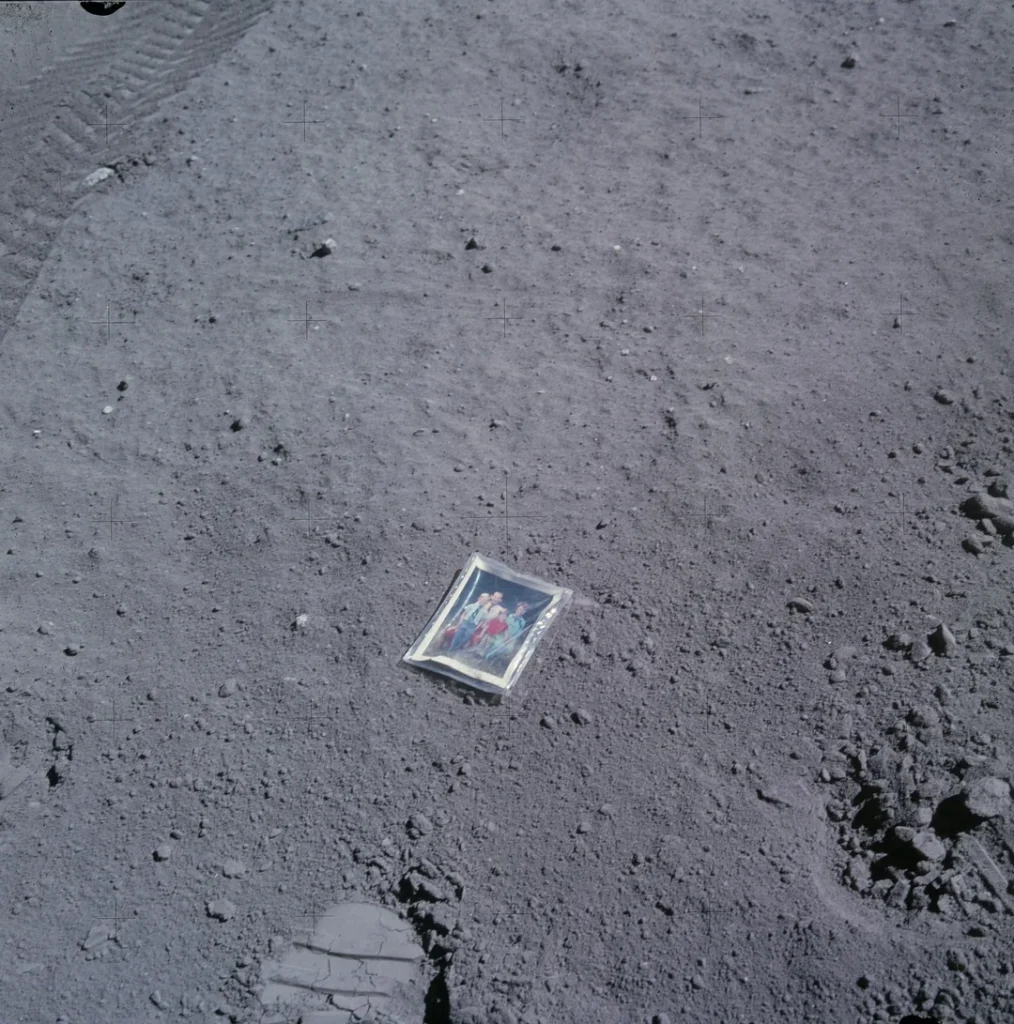
Apollo 16 astronaut Charles Duke left a photograph of his wife and two sons on the lunar surface in April 1972, signed on the back with the message: “This is the family of Astronaut Duke from Planet Earth. Landed on the Moon, April 1972.” The photograph is still there. The moon has no atmosphere to cause it to decompose and no weather to disturb it, so barring a direct meteor strike or a future visitor, it will remain exactly where Duke placed it.
14. Their Vision Changes In Space

A condition called Spaceflight-Associated Neuro-ocular Syndrome, or SANS, causes vision changes in a significant proportion of astronauts who spend extended time in space. The current understanding is that in microgravity, bodily fluids shift toward the head and increase pressure on the optic nerve and the back of the eye, flattening the eyeball and changing its focal length. Astronauts use specially designed glasses in space, and some return with permanently altered vision that does not fully recover on the ground.
15. Guion Bluford Was The First African American In Space

Bluford flew on the Space Shuttle Challenger in August 1983 as a mission specialist, becoming the first African American to reach space. He went on to complete four missions in total. His first flight came twenty years after the civil rights movement was fighting for basic legal equality, and the gap between those two timelines is worth sitting with for a moment.
16. Sally Ride Was The First American Woman In Space

Ride flew on the Space Shuttle Challenger in June 1983, becoming both the first American woman and the youngest American astronaut to reach space at 32 years old. She had responded to a NASA newspaper advertisement recruiting mission specialists, one of over 8,000 applicants. She was selected from that group along with five other women in the 1978 class, the first NASA intake to include female candidates.
17. Astronaut Candidates Undergo Centrifuge Training

To prepare for the extreme g-forces experienced during launch and re-entry, candidates are strapped into a centrifuge and spun at forces that compress the blood into the lower body, starving the brain of oxygen. The training teaches them to perform anti-g maneuvers, tightening muscles to keep blood in the upper body, and to recognize the onset of tunnel vision before they lose consciousness. It is one of the more unpleasant parts of preparation and one of the more necessary ones.
18. They Train In A Plane Called The Vomit Comet

Zero-gravity training on Earth is conducted aboard a modified aircraft that flies in a series of steep parabolic arcs. At the top of each arc the aircraft and everyone inside it are briefly weightless for about 25 seconds, then pulled back toward the ground with roughly 1.8 times the normal force of gravity. The cycle repeats 40 to 60 times per flight. The name the aircraft acquired from the physiological response that many first-time passengers have to the experience is not officially sanctioned but universally understood.
19. NASA Uses Virtual Reality To Prepare Astronauts

Modern astronaut training includes extensive use of virtual reality to simulate spacewalks, emergency repairs, and equipment failures before they happen in orbit. VR allows astronauts to practice procedures in environments that would be impossible to fully replicate on the ground, including the interior of the ISS in zero gravity, the exterior of the station during a spacewalk, and scenarios involving systems malfunctions in conditions where the consequences of getting it wrong are immediately visible.
20. The International Space Station Travels At 17,500 Miles Per Hour

At that speed the station completes a full orbit of Earth every 90 minutes. To maintain that orbit without falling back to Earth requires constant minor adjustments from onboard thrusters and periodic reboosts from visiting spacecraft. If the station slowed significantly it would begin to drop, and if it accelerated it would drift into a higher orbit. The orbital mechanics that keep eight people alive in a tin can 250 miles above Earth are maintained continuously and automatically, which is one of the more remarkable ongoing engineering achievements in human history.
21. Space Smells Like Burnt Steak And Gunpowder

Multiple astronauts have described the smell that clings to spacesuits and equipment after a spacewalk as a combination of seared metal, burnt steak, and gunpowder. The odor comes from high-energy atomic oxygen in space reacting with the suits’ materials. Since smell requires air molecules and space is essentially a vacuum, the scent is only detectable once the astronaut and their equipment are back inside the pressurized airlock. It is not unpleasant, apparently, just very specific.
22. They Cannot Cry In Space

Tears form in microgravity but do not fall. Without gravity to pull the liquid downward, tears accumulate as a growing liquid ball on the surface of the eye, held there by surface tension, until they become large enough to detach and float away as a wobbling sphere. Astronaut Chris Hadfield documented this with a demonstration video that became widely viewed. The physics works against any traditional expression of overwhelming emotion.
23. Food Tastes Different In Space

Fluid shifts toward the head in microgravity, causing congestion that muffles the sense of smell, which is responsible for a significant portion of what we experience as taste. Astronauts consistently report that food tastes bland in space and that they crave stronger flavors, particularly spicy and salty foods, more than they do on Earth. The phenomenon is similar to what happens when you have a bad cold. NASA has spent considerable effort developing space food with enough flavor intensity to get around it.
24. Astronauts Cannot Burp In Space

On Earth, carbonation rises to the top of the stomach and is expelled as gas. In microgravity there is no top or bottom inside a stomach, so gas and liquid are not separated by gravity and any attempt to burp would expel liquid rather than gas. For this reason carbonated drinks are not served on the ISS. The problem is one of the more entertainingly undignified realities of life in orbit, and it is the kind of detail that promotional materials for space programs rarely lead with.
25. Returning To Earth Is Physically Brutal

After months in microgravity, re-entry subjects astronauts to forces several times normal gravity, which their weakened muscles and cardiovascular systems are poorly equipped to handle. Many cannot walk unassisted after landing and are carried from the capsule by medical staff. Rehabilitation after a six-month mission typically takes three to six months. The astronauts who return from the ISS looking cheerful and waving in those landing photographs are performing a feat of willpower that is entirely separate from anything the mission itself required.
26. The Moon Has Footprints That Will Last Millions Of Years

With no atmosphere, no weather, and no wind, the footprints left by the twelve astronauts who walked on the lunar surface between 1969 and 1972 will remain essentially intact for millions of years unless disturbed by a meteorite impact. The only forces that gradually erase them are the slow bombardment of micrometeorites and solar radiation that erosively smooths the surface over geological timescales. By human timescales they are permanent.
27. Valentina Tereshkova Was The First Woman In Space

Soviet cosmonaut Valentina Tereshkova orbited Earth 48 times over three days in June 1963, becoming the first woman in space, a full twenty years before Sally Ride’s flight. She was a textile worker and amateur parachutist before being selected as a cosmonaut candidate. She remains the only woman to have completed a solo spaceflight and has not returned to space since, though she has served in Russian politics for decades and reportedly offered to go to Mars on a one-way mission.
28. Astronauts Are Exposed To Significant Radiation

Outside the protection of Earth’s magnetic field and atmosphere, astronauts are exposed to cosmic radiation at levels that would be dangerous with prolonged exposure. A six-month ISS mission exposes a crew member to roughly the equivalent radiation of 150 chest X-rays. Long-duration missions beyond Earth’s orbit, such as a trip to Mars, would expose astronauts to radiation levels that current shielding technology cannot adequately address, which is one of the primary unsolved problems of deep space human exploration.
29. The Word “Astronaut” Was First Used In Fiction

The term appeared in print in Percy Greg’s 1880 science fiction novel Across the Zodiac, referring to a spacecraft he called the Astronaut. The word was later used by Neil R. Jones in a 1931 short story before being formally adopted by the space programs of the mid-twentieth century to describe actual human space travelers. The science fiction writers who coined the language of space exploration did so in a world where the technology to make it real was still decades away.












